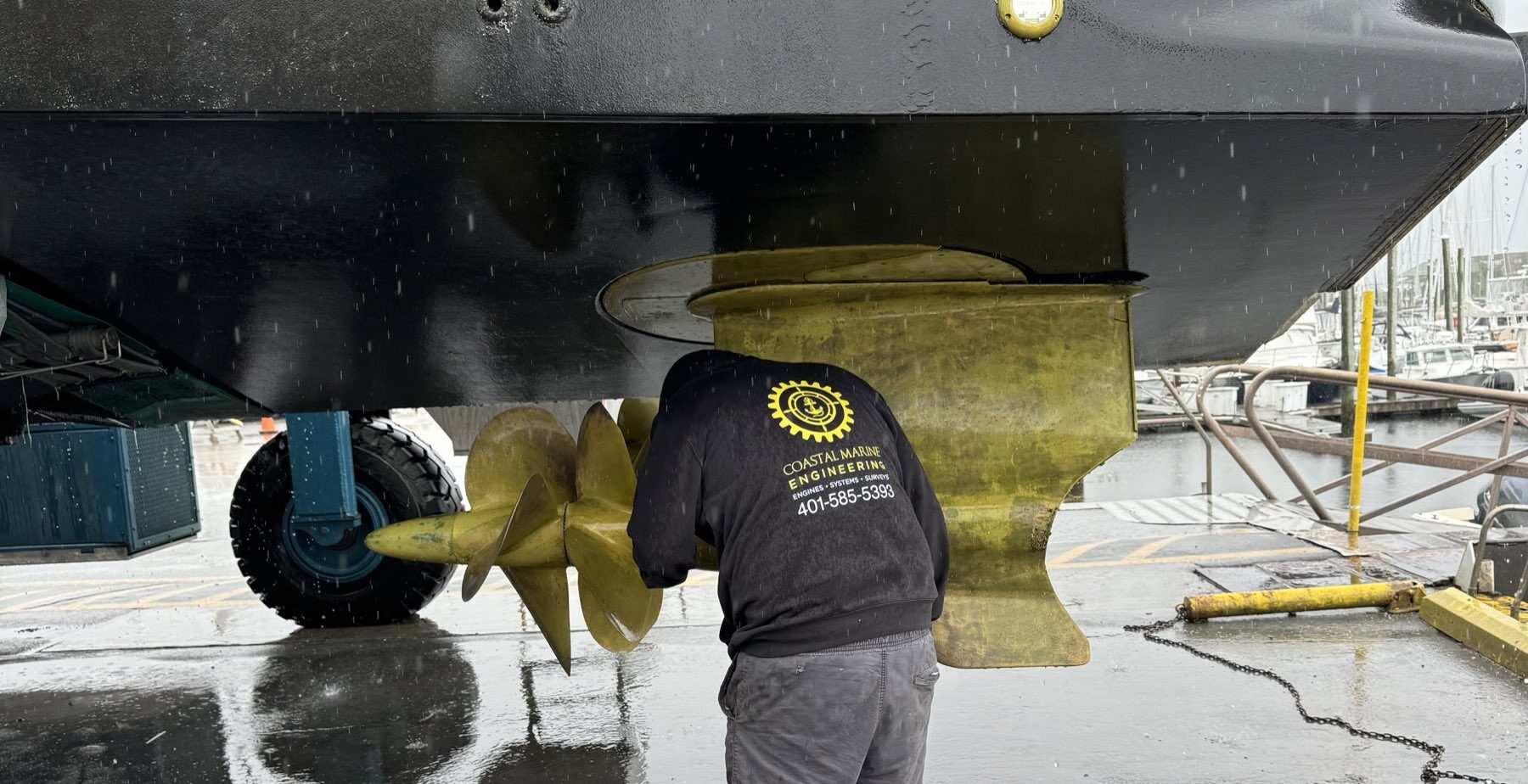
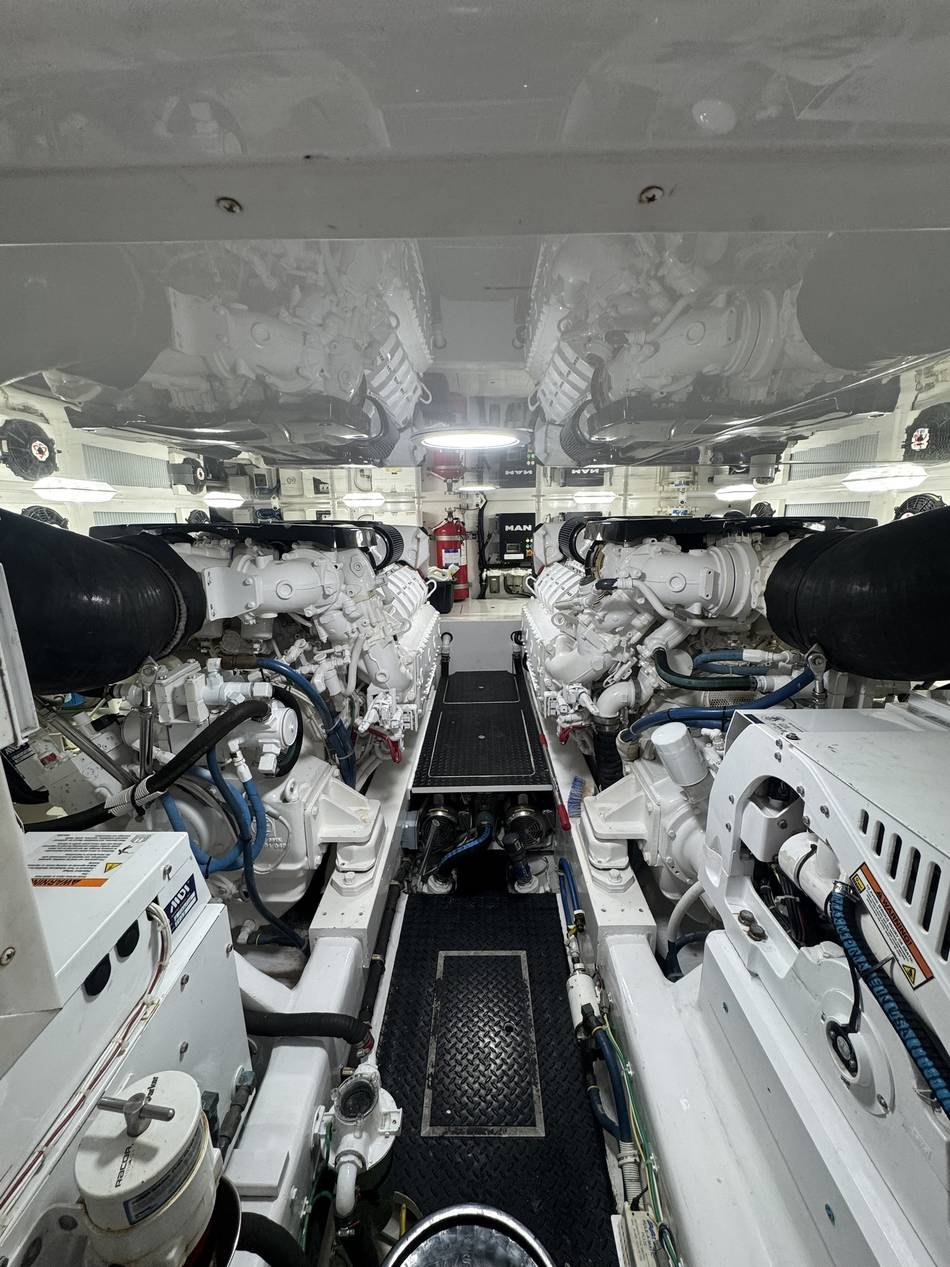
A marine propulsion diesel can carry heavy load for hours at a stretch, and everything it doesn’t turn into thrust has to go somewhere. That somewhere is seawater, pushed through heat exchangers and coolers that foul, corrode and eventually leak.
A neglected heat exchanger costs you speed and temperature margin. A failed aftercooler can do far worse. Knowing how the system works, and what it looks like inside, is the best way to catch problems while they’re still a service item.
Two circuits, one job
Most modern marine diesels run two separate cooling circuits:
- Closed (fresh-water) circuit: treated coolant circulates through the block, head and related components and carries heat away from them.
- Raw-water circuit: seawater comes in through the seacock and strainer, passes through the coolers, and usually goes overboard through the exhaust.
Depending on the engine, the raw-water side may pass through the engine heat exchanger, the charge-air cooler (aftercooler), transmission and engine oil coolers, a fuel cooler and the exhaust mixing elbow. The two circuits exchange heat without ever being meant to mix. The routing differs from engine to engine, so we work from the manufacturer’s cooling diagram, not from memory.
Why heat exchangers lose capacity
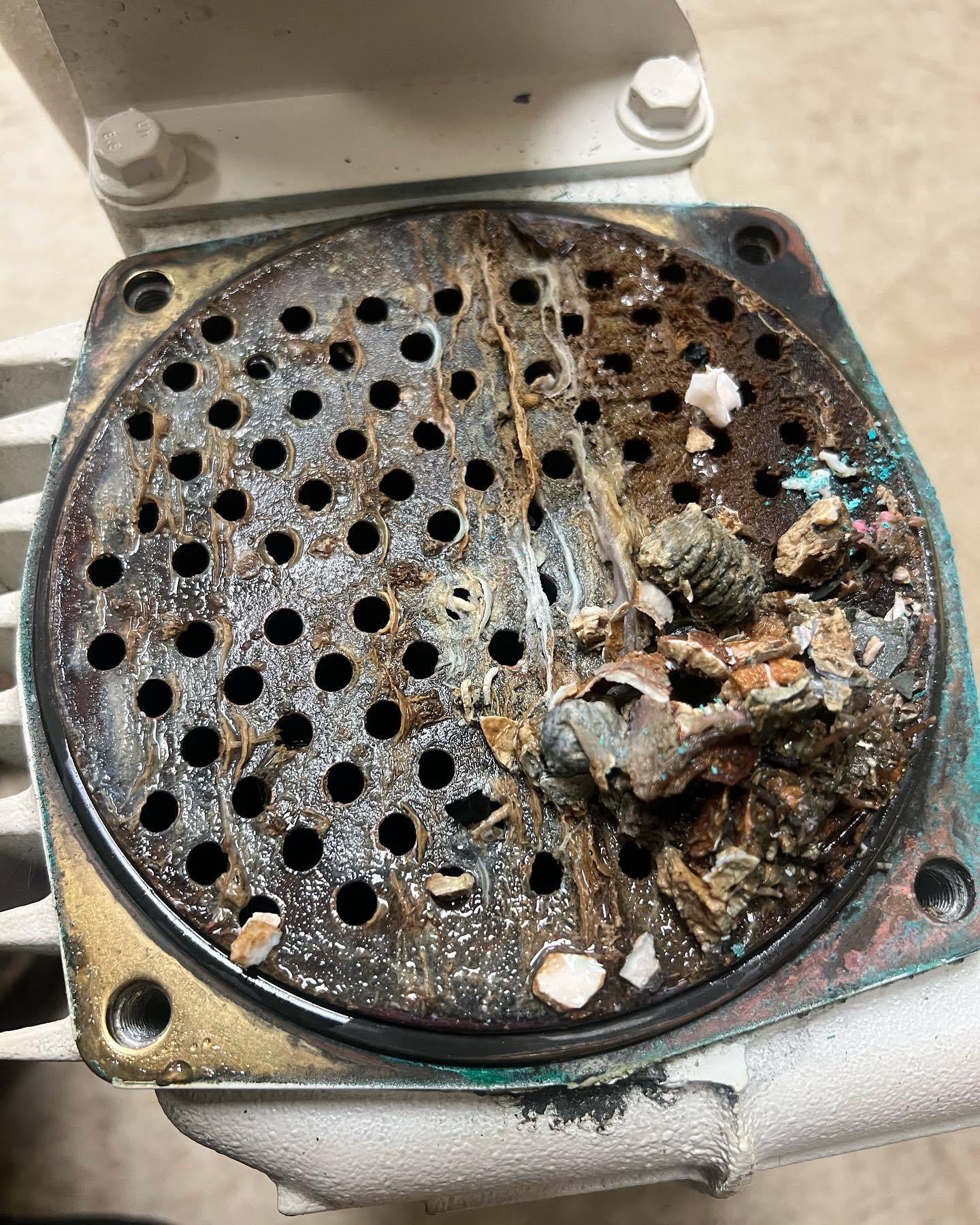
Seawater leaves deposits behind: mineral scale, marine growth, sediment, salt and corrosion products. Each layer insulates the tubes and narrows the passages, so less heat gets out of the coolant.
A partly blocked exchanger can hold normal temperature at idle and dockside and still fall behind after twenty minutes at cruise. That’s why we test cooling performance under real load on a sea trial, not just with the engine idling at the dock.
Engineering view · what a thin layer of scale really costs
Heat leaving a heat exchanger has to cross a chain of thermal resistances in series, from the coolant film, through the tube wall, to the seawater film:
U = overall heat-transfer coefficient · A = tube area · ΔTlm = log-mean temperature difference · Rf = fouling resistance
Copper and copper-nickel tubes conduct heat well, so the wall term is small. Mineral scale is the opposite: its thermal conductivity is roughly 25 to 200 times lower than the tube metal, depending on the alloy and the deposit. A single millimeter of scale can resist heat flow like a tube wall tens of times thicker, and it does it across every square inch of the bundle. On top of that, growth and debris that block tubes reduce A and choke seawater flow, which lowers hsea and ΔTlm at the same time.
There’s a local wrinkle as well. Coolers are sized with margin for warm water. In a Narragansett Bay spring, a fouled cooler can still keep up. The same boat in August water, or headed south, runs out of margin, and that’s when the “sudden” overheat shows up.

Zinc debris
Sacrificial anodes that aren’t changed on schedule break apart and the pieces wash downstream into the cooler tubes. Changing zincs on time is one of the cheapest ways to protect a heat exchanger.
Aftercooler failures: the expensive one
The aftercooler cools compressed air from the turbo before it reaches the cylinders. Cooler air is denser, so more oxygen gets in and the engine makes more power.
Engineering view · why charge-air temperature is horsepower
At a given boost pressure, the mass of air in each cylinder follows the ideal gas law:
ρ = charge density · P = absolute manifold pressure · R = gas constant for air · T = absolute charge temperature (K)
Density goes with absolute temperature. If a fouled aftercooler lets intake air run 70 °C instead of 45 °C, the ratio is 318 K / 343 K: about 7% less air in every cylinder at the same boost. The engine either loses that power, or burns the same fuel in less air, with higher exhaust temperature and more smoke. And a hotter charge raises compression temperatures and piston thermal load. A dirty aftercooler costs you speed and engine life at the same time.
The air side counts too
Most cooling service focuses on the seawater side of the aftercooler, because that’s where the shells and growth are. But an aftercooler has two sides, and the charge-air side fouls as well. Oil mist from crankcase ventilation and turbo seals, soot and fine dirt bake onto the fins and tubes into a sticky film that collects more dirt.
That film matters more than it looks, because air is a far worse heat-transfer medium than water. On a charge-air cooler, the air-side film coefficient is typically much lower than the water side’s, so the air side usually sets the limit on how much heat the core can reject. A thin coating there can cost as much cooling as a heavy layer of scale on the water side. Air-side deposits also narrow the passages, so the turbo has to push harder through a bigger pressure drop to deliver the same manifold pressure.
A flush through the water side never touches any of this. The core has to come out and both sides have to be cleaned, which is why we put aftercooler cores through the ultrasonic tank whole rather than rodding the tubes and calling it done.
“It doesn’t overheat” doesn’t mean the intake air is cool
This is the misconception we run into most. The engine temperature gauge reads coolant temperature. On a seawater-cooled aftercooler, the charge air is cooled on a separate path the coolant gauge never sees. On engines where the aftercooler sits in the closed circuit, the thermostat and heat exchanger hold coolant temperature steady while the air coming out of the core quietly runs hotter. Either way, the gauge can sit right where it always has while intake air temperature climbs well past where it should be.
What you notice instead:
- The boat slowly loses top-end speed and RPM
- Exhaust temperatures creep up at the same throttle setting
- More smoke under load
- On electronic engines, a derate or an intake-temperature warning, sometimes only on hot days
The way to know is to measure it. On electronic engines we read intake manifold air temperature from the ECU under sustained load and compare it to spec. On any engine, we can measure charge-air temperature into and out of the aftercooler and the seawater temperature, which shows how much work the core is actually doing. A cooler that should drop charge air most of the way to seawater temperature but only manages part of that drop is fouled, whatever the coolant gauge says.
On seawater-cooled aftercoolers, a breach between the water side and the air side can let seawater into the intake. How much gets in depends on where the leak is, the pressure difference and how the engine is running, but the possible results include:
- Internal corrosion of intake components
- Abnormal combustion and misfire
- Cylinder liner and valve damage
- Hydraulic lock and severe mechanical damage if enough water reaches a cylinder
If you suspect water ingestion
Don’t keep cranking or restart the engine. Leave it shut down until it has been inspected. A few minutes of patience can be the difference between an aftercooler repair and an engine rebuild.

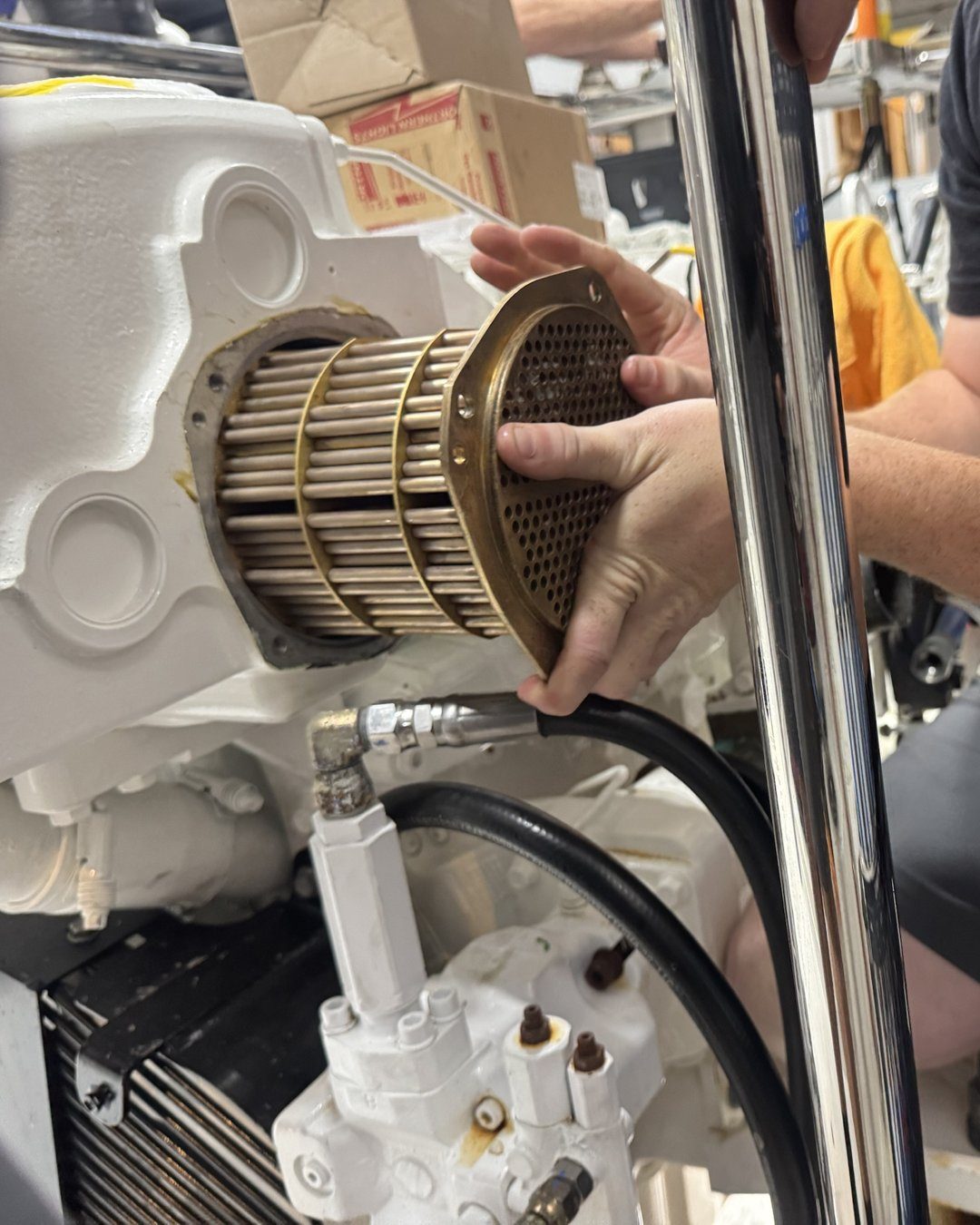
Aftercooler core out for cleaning, not replacement.
A fouled aftercooler steals power so gradually that most owners don’t notice until the boat won’t make its old cruising speed. We rigged a chain fall over the engine, lifted the core out in one piece, and cleaned it in our ultrasonic tank instead of replacing it.
- Engine
- Caterpillar marine
- Scope
- Aftercooler pull, clean, reinstall
- Rigging
- Chain fall over the engine
Warning signs of a tired cooling system
- Operating temperature creeping up over a season
- Overheating only under sustained load
- Lost top-end performance
- Coolant loss you can’t trace
- Corrosion or weeping around cooler end caps and housings
- Salt crust or seawater tracks on the engine
- Moisture or residue inside the intake tract
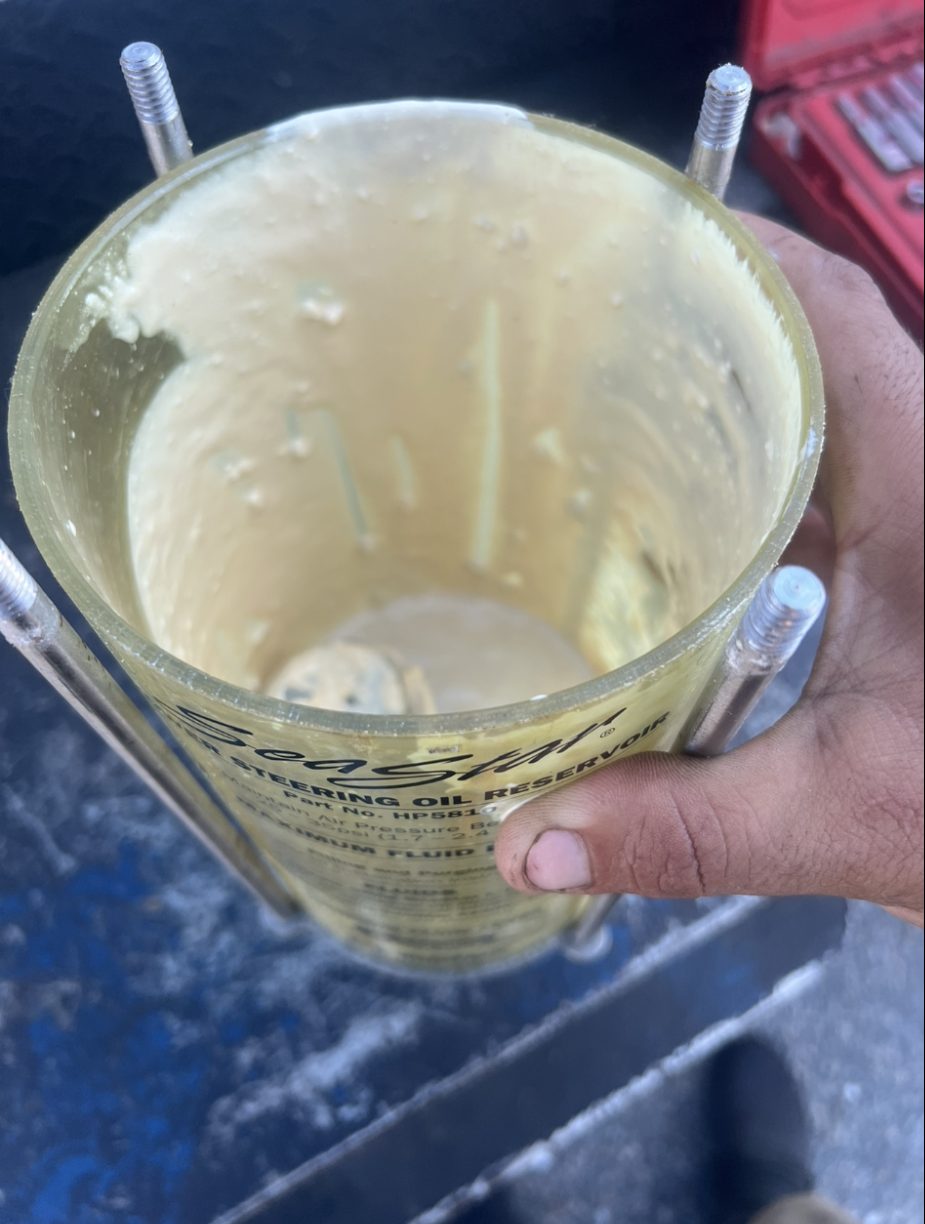
- Milky or contaminated oil in an oil-to-water cooler circuit
Not every cooling problem sets off a temperature alarm. Internal leaks and localized corrosion can be well along before anything changes on the display.
Why cleaning the outside isn’t enough
A heat exchanger can look clean on the outside and still be badly restricted inside. An aftercooler can look serviceable until it comes apart and shows packed tubes, failed seals or corrosion eating into a sealing face. A proper cooling service includes:
- Draining and isolating the right circuits.
- Removing the designated cooling components.
- Disassembling serviceable exchangers and aftercoolers.
- Inspecting internal passages and sealing surfaces.
- Cleaning with approved methods.
- Inspecting for corrosion, erosion and physical damage.
- Pressure testing where required.
- Replacing gaskets, O-rings and seals.
- Reassembling to the manufacturer’s procedure.
- Refilling, bleeding and testing the system.
Pressure testing is the step that gets skipped most often, and it’s the only reliable way to find a leak you can’t see.
What about Barnacle Buster and other flush descalers?
Circulating descalers such as Barnacle Buster are popular because they promise a clean cooling system without taking anything apart: hook up a pump, circulate the solution through the raw-water side, flush, done. They can dissolve some light mineral scale. In our experience they don’t fix the coolers that actually cause problems, and the reasons are straightforward:
- Flow takes the easy path. A circulated solution goes through the tubes that are already open. A tube packed solid with shell, growth or zinc debris gets little or no flow, so it never gets cleaned. Those are exactly the tubes you need back.
- Acid doesn’t dissolve debris. Broken zinc pieces, impeller vanes, shell fragments and silt don’t dissolve. They’re still sitting on the tube sheet when the flush is over.
- It never reaches the air side. Oil and soot on the aftercooler’s charge-air side are untouched by anything pumped through the water side.
- No inspection, no pressure test. You never see the tube sheet, the end-cap seals or the corrosion, and you never find out whether the core leaks.
Sometimes a flush “works” in the sense that temperature drops a few degrees. That usually means a few marginal tubes opened up, while the blocked ones and the air side are just as they were. For a cooler that’s actually costing you performance, it has to come apart.
Ultrasonic cleaning: what it does and doesn’t do
An ultrasonic tank sends high-frequency sound through a cleaning solution. That creates microscopic cavitation bubbles that collapse against every wetted surface and break deposits loose from places a rod or brush can’t reach.
Used correctly, it’s one of the most effective ways to restore heat exchangers, cooler cores and housings. It isn’t a substitute for inspection, pressure testing or replacing parts that are worn out. And chemistry, temperature and exposure time all have to suit the material: some aluminum alloys, coatings and brazed assemblies can be damaged by the wrong treatment.
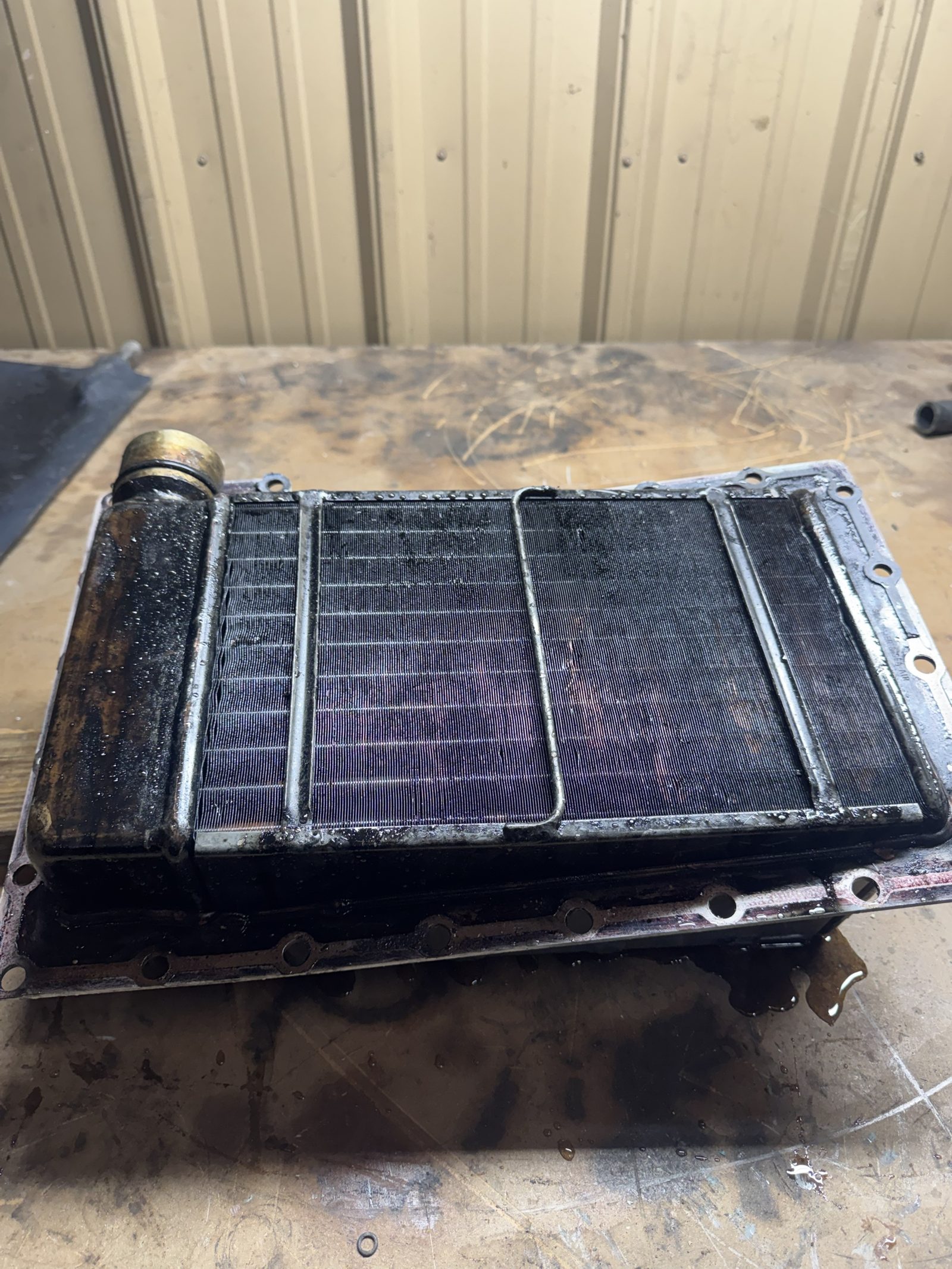
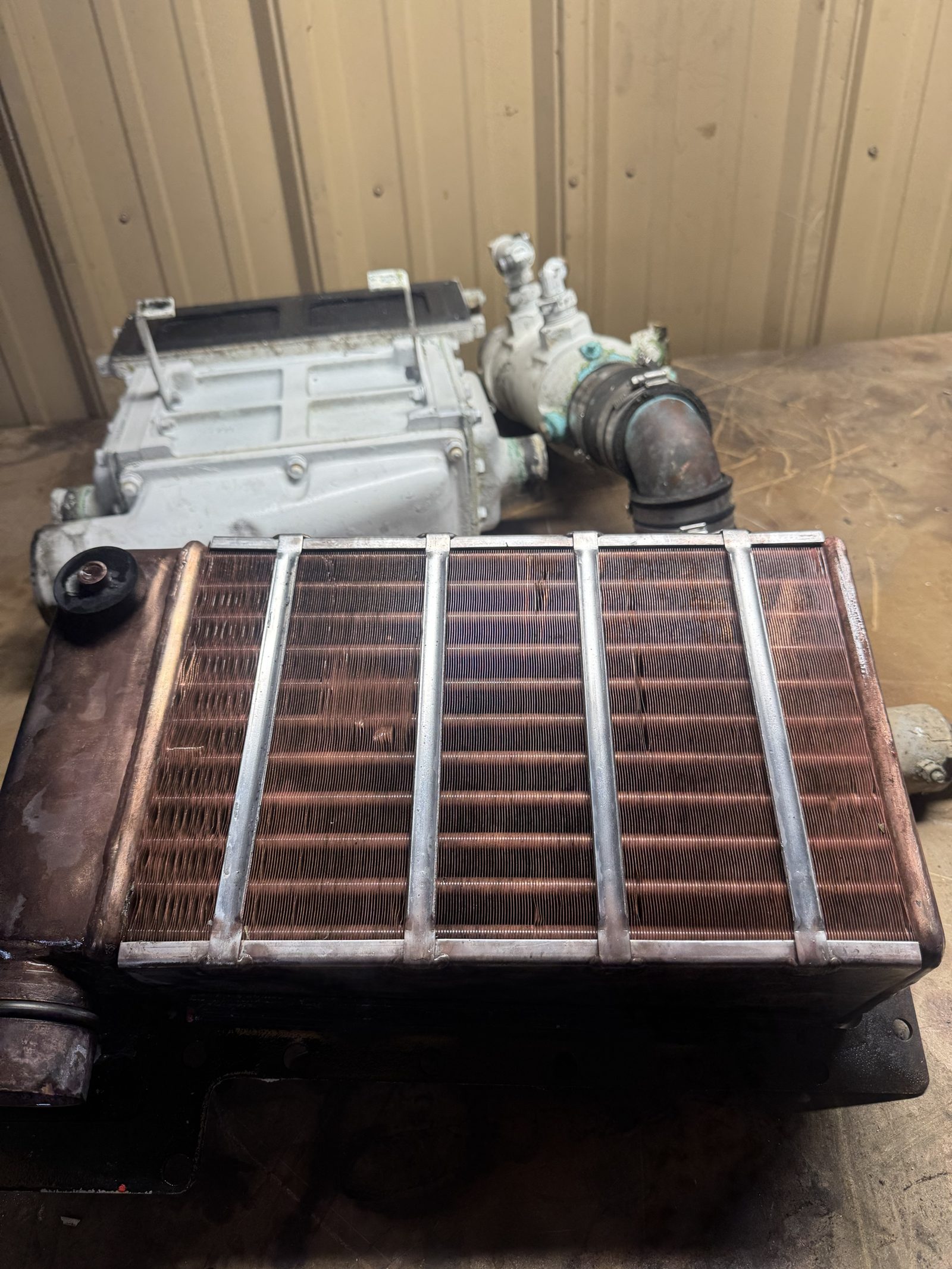
Same aftercooler core, before and after a run in our ultrasonic tank

How often should coolers be serviced?
There’s no single interval that fits every engine. The right one depends on the manufacturer, the engine model, where and how much the boat runs, water quality and the maintenance history. Follow the manufacturer’s schedule, and don’t use the temperature gauge as your only health check. An engine running at normal temperature today can still have heavy deposits and a cooler that’s getting close to failing.
Why preventive service pays
A cooling service done on your schedule is a planned cost. A leaking aftercooler or a choked exchanger found by an overheat alarm offshore is not, and the damage rarely stops at the cooler. If you’re planning a long cruise, have the cooling system checked before you leave. And a documented service history is exactly what a buyer’s surveyor wants to see.
From our shop
Our in-house ultrasonic tank takes heat exchangers, aftercooler cores, oil coolers and more, typically turned around in 2–3 days. See heat exchanger & aftercooler cleaning.
All cleaning, pressure testing and reassembly should follow the applicable engine and component manufacturer’s requirements.